Nová Cvernovka
Nová Cvernovka is a socio-cultural centre in the north of the Slovak capital Bratislava. It is located in the building complex of a former chemistry college from the 1950s, which was extended by a residential home. Since 2015, the buildings and the surrounding grounds have been rented by the “Nadácia Cvernovka” Foundation for an initial period of use of 25 years. Since its inception, the “Nová Cvernovka” project has developed into an important creative landmark of the cultural scene in Bratislava.
Research project “Centre for Metropolitan Innovation in Bratislava” (CMI.BA)
Due to the age and structural condition, modernisation of the buildings is necessary to meet today’s ecological requirements. Within the framework of a research project funded by the “Deutsche Bundesstiftung Umwelt” (DBU), a concept for a socio-ecological transformation of the former dormitory is therefore being developed that combines high ecological goals with long-term favourable rents, low operating costs and favourable life cycle costs. The current residents are involved in the planning processes. CMI.BA is thus intended to become a model project of ecologically and socially sustainable building modernisation that combines innovative approaches of social use, participatory planning and ecological building renovation to realise the first plus-energy building in Slovakia. Due to the representative building typology, this project has a great transfer potential for similar projects in Slovakia and other European countries.
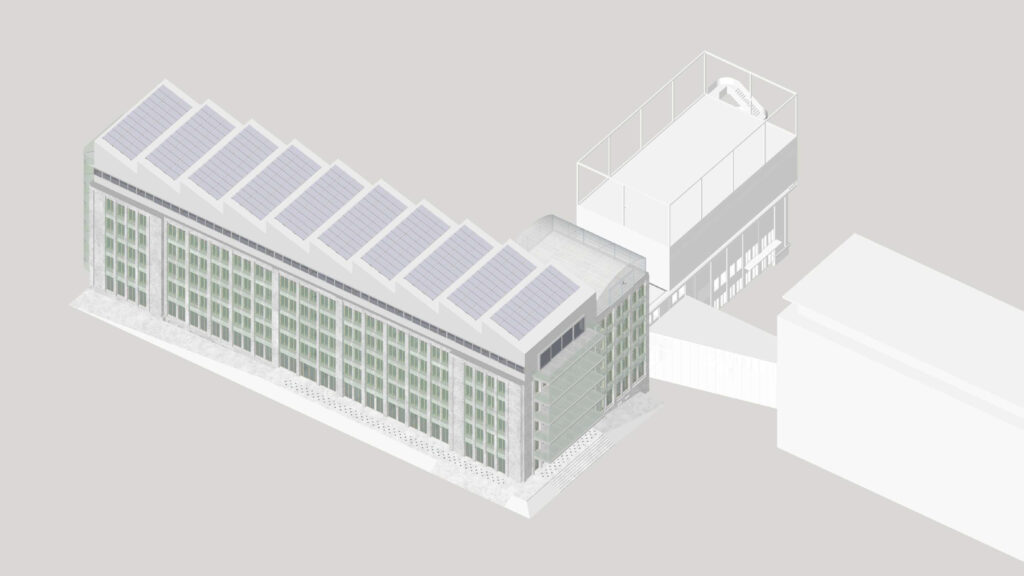
Main focus: Community living, working, art and culture
In the future, the refurbished rooms of Nová Cvernovka will offer office and coworking space and rooms for social and cultural functions in addition to communal forms of living. This complements the existing offer of “Nová Cvernovka”, which mainly organises cultural events, concerts, theatre performances, lectures, discussion events, exhibitions and workshops. In the future, a park, restaurant, sports facilities, galleries, a library, a public garden and a children’s playground will be built in the other parts of the area. “Nová Cvernovka” as a place for social and technological innovations will thus be complemented by further uses.
Research fields of action and project partners
The CMI.BA research project comprises four central fields of action, which are implemented by the following project partners.
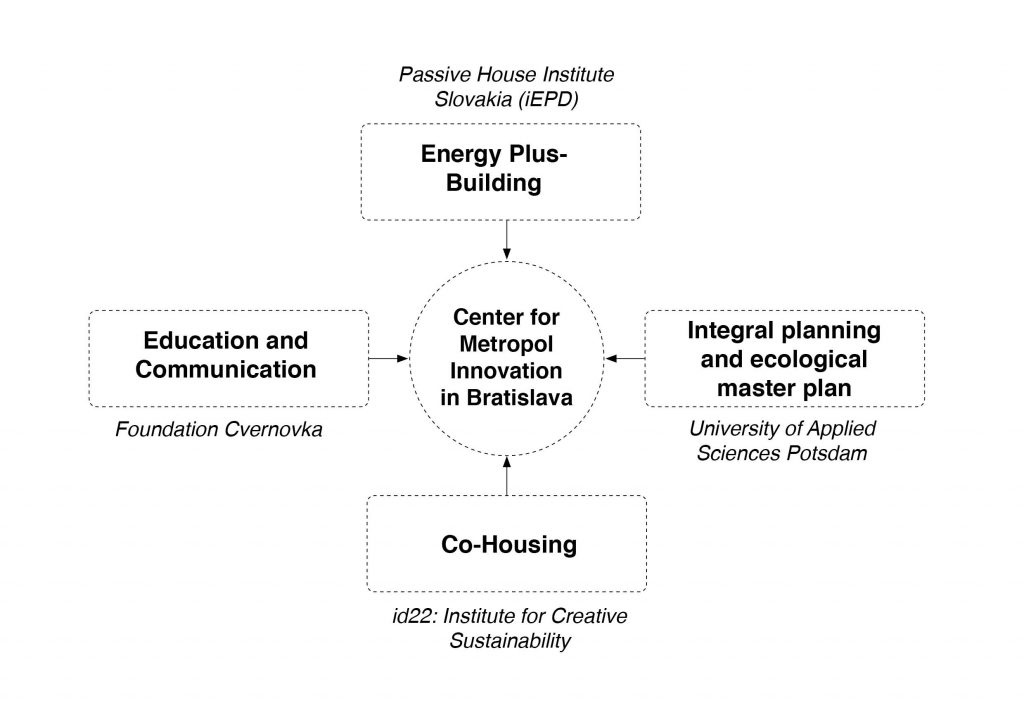
Nadácia Cvernovka: Education and Communication
The Nadácia Cvernovka Foundation was established with the aim of renovating the former industrial area of Cvernovka in Bratislava and filling it with life by offering social, cultural and financial support to artists and the public. In this way, the foundation wants to contribute to the improvement of living conditions and perspectives in the city and in society. The revitalisation of the Cvernovka area is gradually creating a cultural and meeting centre in Bratislava. The fields of action of the “Nadácia Cvernovka” Foundation in the CMI.BA project include communication with stakeholders and public administrations, public relations work and the preparation of planning documentation for the plus-energy building.
Potsdam University of Applied Sciences: Integral planning and ecological building methods
The “Institute for Applied Research Urban Future” (IaF) is an interdisciplinary research institution of the “Potsdam University of Applied Sciences” (FHP) and was founded in 2014. Under the research focus “Design – Build – Maintain”, various questions concerning the physical, spatial and social dimensions of sustainable development of the built environment are investigated. Within the CMI.BA project, the FH Potsdam team leads and coordinates the work of all project partners and develops an overall ecological concept. An important building block for this is integral planning, through which all important stakeholders are involved in the planning process at an early stage. The FHP is also mainly responsible for collecting “best practice” examples and creating the socio-ecological design patterns.
Institute for Creative Sustainability (id22): Co-Housing and Social Innovation
id22 is an interdisciplinary, non-profit organisation in Berlin that researches and supports collaborative forms of housing in the context of sustainable, cooperative urban development. Inclusion and self-organisation are at the forefront. For many years, id22 has been doing research, education and networking work and has published numerous papers on participatory and communal housing cultures (CoHousing Cultures). The development of housing concepts and the monitoring of the participation process are the central fields of action of the “Institute for Creative Sustainability” in the CMI.BA project.
Passive House Institute Slovakia (iEPD): Plus-Energy-Buildings
The Passive House Institute (iEPD) is a non-political, voluntary, non-governmental organisation. As an association, iEPD promotes the development of sustainable architecture and open spaces in Slovakia and, in particular, the provision of information and knowledge on the construction of passive houses. iEPD has been involved in the implementation of many national and international research projects. In the CMI.BA project, iEPD is investigating the energy status of the building and developing an energy concept for converting it into a plus-energy building.